


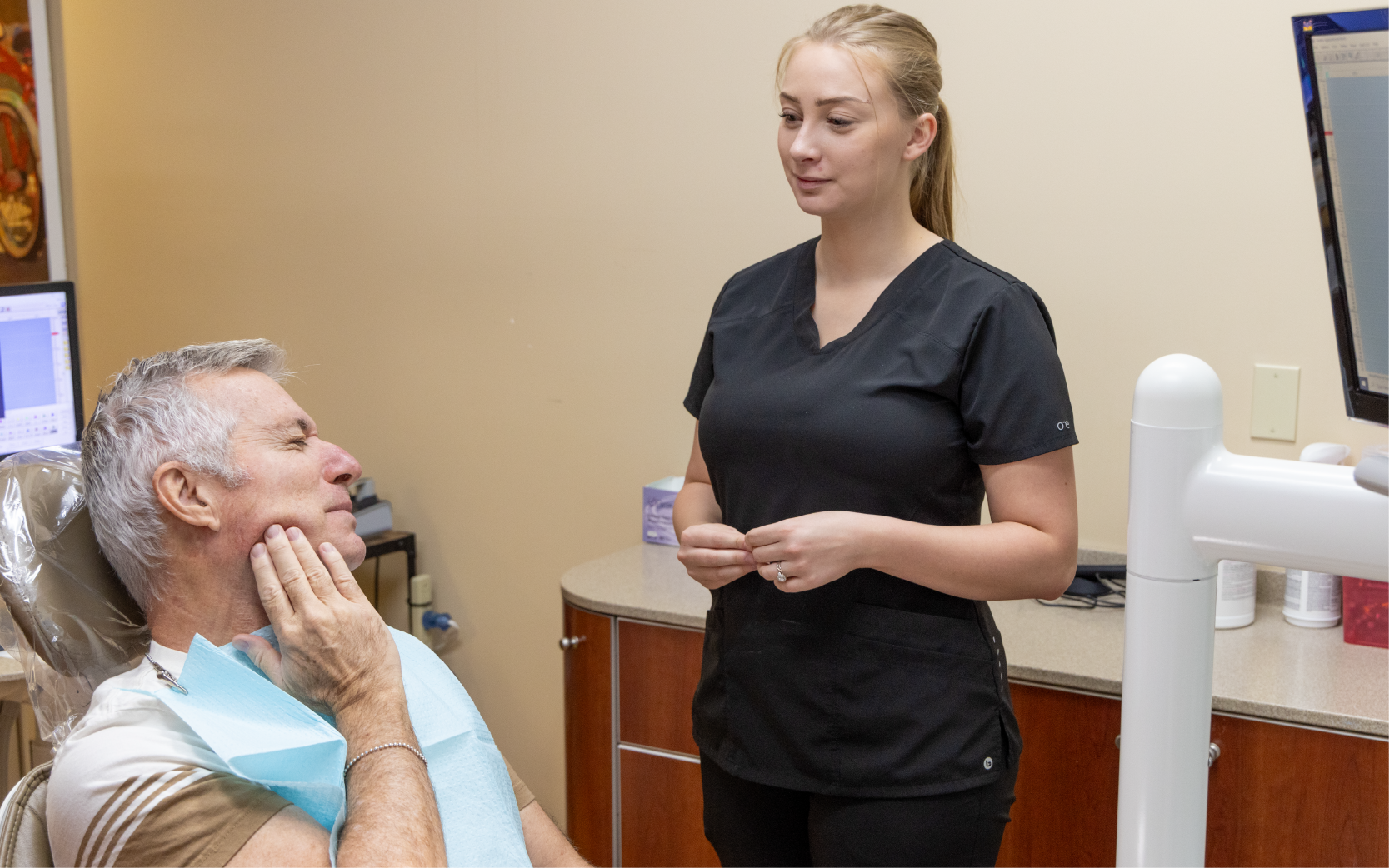
A toothache, a broken tooth, or a swollen jaw can stop your day in its tracks. At Padden Dental in Vancouver, WA, we set aside time for urgent dental problems and do our best to see you the same day. New and existing patients are welcome. If you live in Salmon Creek, Hazel Dell, Felida, Orchards, or anywhere in Clark County, call us at (360) 213-1999 as soon as you notice a problem. For our main emergency page, see emergency dental care in Vancouver, WA.
Office hours for emergency calls: Monday through Thursday, 8 a.m. to 5 p.m., and Friday, 8 a.m. to 4 p.m.
Common Dental Emergencies We Treat
- Toothache. Throbbing or lingering pain can mean a deep cavity, a cracked tooth, or an infection.
- Broken or chipped tooth. Even a small chip can leave a sharp edge or expose the sensitive inside of the tooth.
- Lost filling or crown. The tooth underneath may be sensitive and more likely to break.
- Swelling in the face or gums. Swelling often means infection and should be checked quickly.
- Knocked-out or loose tooth. Fast action gives the best chance of saving the tooth.
- Pain around a wisdom tooth. Partly erupted wisdom teeth can trap food and become infected.
- Bleeding or sore gums that do not settle down.
- Broken dentures or a loose implant crown.
What to Do Before Your Visit
For a toothache: Rinse with warm salt water and gently floss around the tooth to remove any trapped food. An over-the-counter pain reliever, taken as directed on the label, may help. Do not put aspirin directly on the gums.
For a broken tooth: Save any pieces in a clean container. Rinse your mouth with warm water and use a cold compress on your cheek if there is swelling.
For a knocked-out adult tooth: Pick it up by the top (the crown), not the root. If it is dirty, rinse it gently with milk or water without scrubbing. If you can, place it back in the socket and bite gently on a clean cloth. If not, keep it in a small container of milk and call us right away.
For a lost crown: Keep the crown and bring it with you. Avoid chewing on that side.
For swelling: Use a cold compress on the outside of your cheek and call us. If you have trouble breathing or swallowing, or swelling that is spreading quickly toward your eye or neck, go to the nearest emergency room or call 911.
What Happens at Your Emergency Visit
- We listen. Tell us what happened and where it hurts.
- We find the cause. We examine the area and take digital X-rays or a 3D CBCT scan if needed. Many problems that are hard to see by eye show up clearly on imaging.
- We relieve your pain. Our first goal is to get you comfortable. Depending on the problem, that may mean treating an infection, smoothing or repairing a broken tooth, re-cementing a crown, or starting a root canal.
- We explain your options. Before any treatment, we explain what we found, what we recommend, and what it costs. If a tooth can be saved, we will tell you how. If it cannot, we will talk about options to replace it.
- We plan follow-up care. Some problems are fixed in one visit. Others need a second appointment, such as a permanent crown or the rest of a root canal.
Treatments We Often Provide
- Fillings for chipped or broken teeth
- Same-day CEREC crowns for badly broken teeth, often finished in one visit
- Root canal therapy to save an infected tooth
- Tooth extractions, including wisdom teeth, when a tooth cannot be saved
- Re-cementing loose crowns
- Treatment for gum infections
Nervous About Coming In?
Dental pain is stressful, and so is the dentist for many people. We work gently, explain every step, and check in with you often. If you are very anxious, ask about our sedation options.
Paying for Emergency Care
We accept most dental insurance and can help you understand what your plan covers. If you do not have insurance, we offer a 10% discount for cash or check payments, or 5% for card payments. We also offer 6 months interest-free financing through CareCredit for qualified patients, so you do not have to delay treatment.
Preventing Dental Emergencies
Many emergencies start as small problems. Regular checkups and cleanings, a mouthguard for sports, a night guard if you grind your teeth, and not chewing ice or hard candy all help protect your teeth.
Emergency Dentistry FAQs
Do you see new patients for emergencies?
Yes. Call (360) 213-1999 during office hours and we will do our best to see you the same day.
What counts as a dental emergency?
Severe or lasting tooth pain, swelling, a broken or knocked-out tooth, a lost crown, or bleeding that will not stop are all reasons to call us.
Should I go to the ER for a toothache?
For most toothaches, a dentist is the right place to go, because we can treat the cause. Go to the ER for trouble breathing or swallowing, a high fever with facial swelling, or a serious injury to the face or jaw.
How much does an emergency visit cost?
It depends on what we find and what treatment you need. We will explain costs before we begin.
Where are you located?
8720 NE Centerpointe Dr #221, Vancouver, WA 98665, just off Padden Parkway near I-205, with free parking.
Also read: our guide Dental Emergency in Vancouver, WA? What to Do & Who to Call.
FAQs About Emergency Dental Care
What qualifies as a dental emergency?
Severe pain, swelling, a lost filling or crown, or any issue causing significant discomfort warrants immediate attention. Call us to assess your situation.
Can I get same-day treatment?
Yes, we prioritize same-day appointments when possible for emergencies during regular office hours, Monday through Thursday, 8:00 a.m. to 5:00 p.m., and Friday, 8:00 a.m. to 4:00 p.m.
Is emergency dental care painful?
We use modern anesthesia and gentle techniques to ensure your comfort. Our goal is to relieve your pain quickly and effectively.