


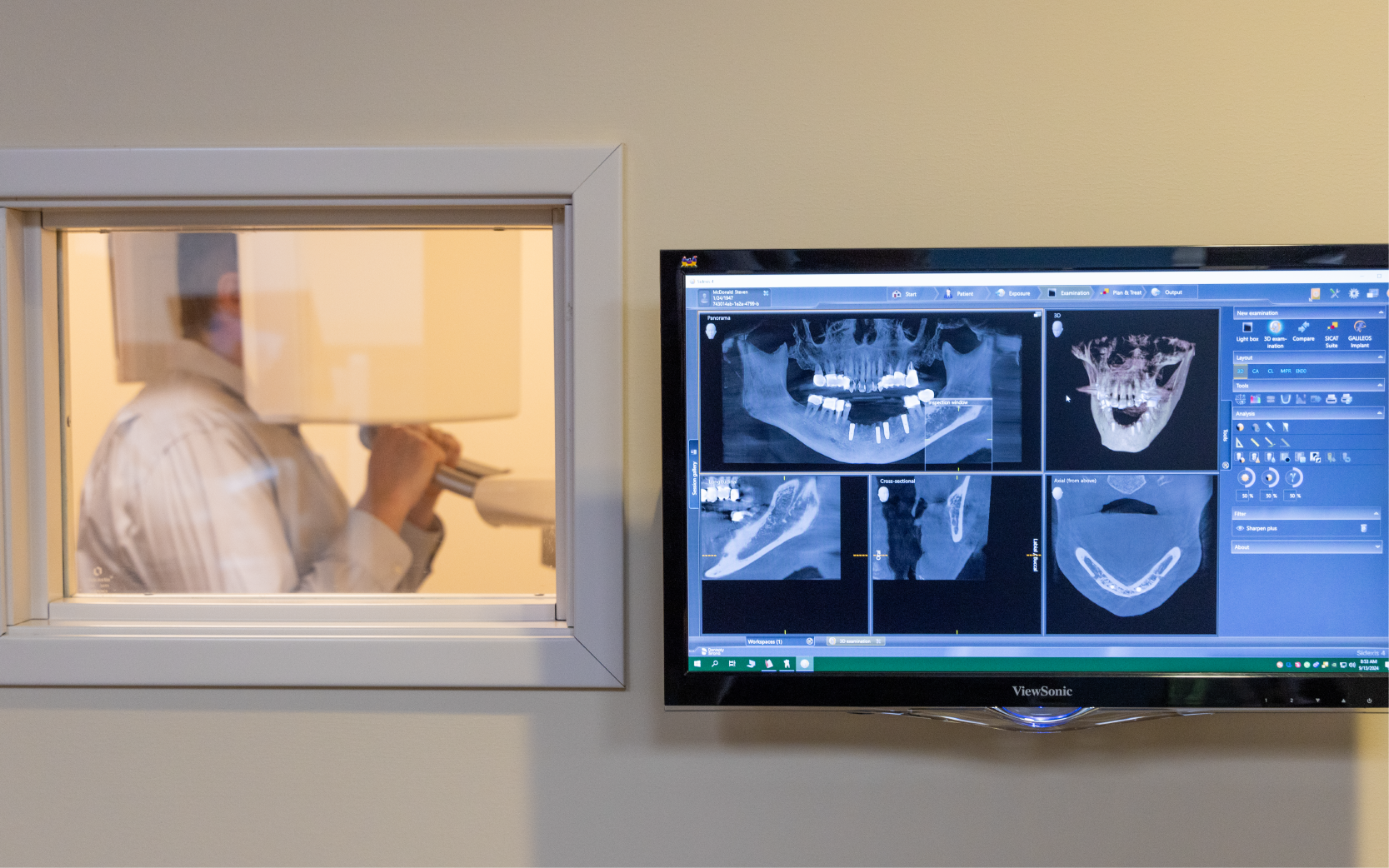
Many dental problems start where you cannot see them: between teeth, under old fillings, below the gum line, or inside the jawbone. At Padden Dental in Vancouver, WA, we use digital X-rays and 3D Cone Beam Computed Tomography (CBCT) imaging to find problems early and plan treatment carefully. Patients from Salmon Creek, Hazel Dell, Felida, Orchards, and across Clark County can get this imaging right in our office, without a separate trip to an imaging center.
What Is Dental Imaging?
Dental imaging is any picture of your teeth and jaws that shows more than a visual exam can. At our office, that includes:- Digital X-rays. These show cavities between teeth, decay under fillings, bone levels around teeth, and the roots of your teeth. Digital X-rays appear on a screen right away, so we can look at them with you during your visit.
- 3D CBCT scans. A CBCT scan takes a three-dimensional picture of your teeth, jawbone, sinuses, and nerve pathways. Instead of a flat image, we can view your mouth from any angle.
- Digital scanners. These create a precise 3D model of your teeth. We use them to plan care and to make same-day crowns in the office, so many patients can leave with their new crown the same visit.
Why Imaging Matters for Your Care
Imaging helps us:- Catch problems early. Small cavities, cracks, infections, and bone loss are easier and less costly to treat when found early.
- Plan treatment precisely. For dental implants and wisdom tooth removal, a 3D scan shows exactly how much bone is available and where nerves and sinuses sit.
- Explain your options clearly. We can show you what we see on the screen, so you understand why a treatment is recommended.
- Track changes over time. Comparing images from visit to visit helps us watch gum health, old fillings, and areas we are keeping an eye on.
How We Use 3D CBCT Imaging
Dental implants. Before placing an implant, we need to know the height, width, and density of your jawbone and the location of nerves and sinuses. A CBCT scan lets Dr. Dahlen plan the implant position carefully before treatment starts. Wisdom teeth. Wisdom teeth are often tilted or partly buried. A 3D scan shows how the roots sit in relation to the nerve in your lower jaw, which helps us plan a safe wisdom tooth extraction. Infections and root canals. Some infections at the tip of a tooth root are hard to see on a flat X-ray. A 3D view can help us find the source of unexplained pain. Orthodontic planning. Imaging helps us review tooth and jaw positions before Invisalign treatment. Complex cases. If a case ever needs outside coordination, your images help us share a clear plan. Most treatment, including implants and wisdom tooth removal, is planned and completed here in our office.What to Expect During a Scan
Imaging is quick and painless:- You remove anything metal around your head and neck, such as earrings or glasses.
- For X-rays, you gently bite on a small sensor. For a CBCT scan, you stand or sit still while the machine rotates around your head, usually for less than a minute.
- We review the images, often with you, during the same visit.
Is Dental Imaging Safe?
Digital X-rays and CBCT scans use low doses of radiation, and we only take images when they help with your diagnosis or treatment. We follow standard safety practices and use protective measures when appropriate. If you are pregnant or think you might be, please tell us before any imaging. We will discuss whether imaging can wait and what is safest for you.Imaging for the Whole Family
We take X-rays for children, teens, and adults as part of routine checkups, based on each person’s age, risk of cavities, and dental history. Not everyone needs the same images at every visit. We recommend imaging based on your needs, not on a fixed schedule.Why Patients Choose Padden Dental
Patients across Vancouver and Clark County choose Padden Dental because we combine modern technology with plain-language explanations. Dr. Eric Dahlen has more than 30 years of experience and has kept our office up to date with tools like CBCT imaging and same-day CEREC crowns. Having imaging in our office means fewer trips, faster answers, and treatment planned around clear information.Dental Imaging FAQs
What is the difference between a regular X-ray and a CBCT scan? A regular dental X-ray is a flat, two-dimensional picture. A CBCT scan is three-dimensional, so we can see the height, width, and depth of bone and the position of nerves and roots. We use CBCT when that extra detail helps with treatment, such as implants or wisdom teeth. How often do I need dental X-rays? It depends on your age, your cavity risk, and your dental history. Some patients need X-rays once a year, others less often. We will recommend a schedule that fits you. Does insurance cover dental imaging? Many dental plans cover routine X-rays, and some cover CBCT scans when they are needed for treatment. Our team can check your benefits. If you do not have insurance, we offer a 10% discount for cash or check payments, or 5% for card, and 6 months interest-free financing through CareCredit for qualified patients. Can I get a scan if I am pregnant? Please let us know if you are pregnant or might be. We usually postpone non-urgent X-rays, and we will talk with you about what is safest. How do I schedule? Call Padden Dental at (360) 213-1999. We are at 8720 NE Centerpointe Dr #221, Vancouver, WA 98665, just off Padden Parkway near I-205.FAQs About Dental Imaging and Mapping
What is CBCT dental imaging?
CBCT, or Cone Beam Computed Tomography, is a type of 3D dental imaging that provides highly detailed views of teeth, bone structures, nerves, and surrounding anatomy for advanced diagnosis and treatment planning.
Why would I need dental imaging?
Dental imaging helps detect hidden problems such as infections, cavities, bone loss, impacted teeth, fractures, and structural concerns that may not be visible during a standard visual examination.
Is dental imaging safe?
Modern digital dental imaging uses lower radiation levels than older imaging systems and is considered safe when used appropriately for diagnostic and treatment planning purposes.
To schedule a consultation for dental imaging,