


What if being told “no” to dental implants was never really the final answer? If you’ve been quietly searching “am i a candidate for dental implants” late at night, you already know the frustration: missing teeth affect how you eat, how you speak, and how confidently you walk into a room. The worry that your situation might be too complicated, too far gone, or simply not fixable is a heavy thing to carry.
That feeling is completely understandable. Most people assume implant candidacy is a simple yes or no decision made in a single appointment. The truth is far more encouraging than that.
This guide is here to change how you think about eligibility. You’ll discover the key health and lifestyle factors dentists actually evaluate, learn how pre-treatments like bone grafting can open the door for patients who’ve previously been turned away, and find out how sedation options make the procedure far more comfortable than you might expect. Whether you have bone loss, health concerns, or just a deep fear of the dental chair, there is almost certainly a path forward. Let’s walk through it together.
Key Takeaways
- If you’ve been wondering “am I a candidate for dental implants,” the answer depends on several key health factors — including jawbone density and gum health — that this guide walks you through clearly.
- Being told “no” to implants isn’t always permanent; pre-treatments like bone grafting and periodontal therapy can rebuild the foundation your smile needs to qualify.
- Modern restorative techniques, including sinus lifts and All-on-4 solutions, have opened the door for patients who previously believed implants were out of reach.
- Advanced 3D imaging and digital scanning allow Dr. Padden to create a personalized candidacy plan based on what’s actually happening beneath your gum line — not a one-size-fits-all checklist.
- Even deep dental anxiety doesn’t have to stand between you and a restored smile; sedation dentistry makes the entire process far more comfortable than most patients expect.
The 2026 Checklist: Core Requirements for Dental Implant Success
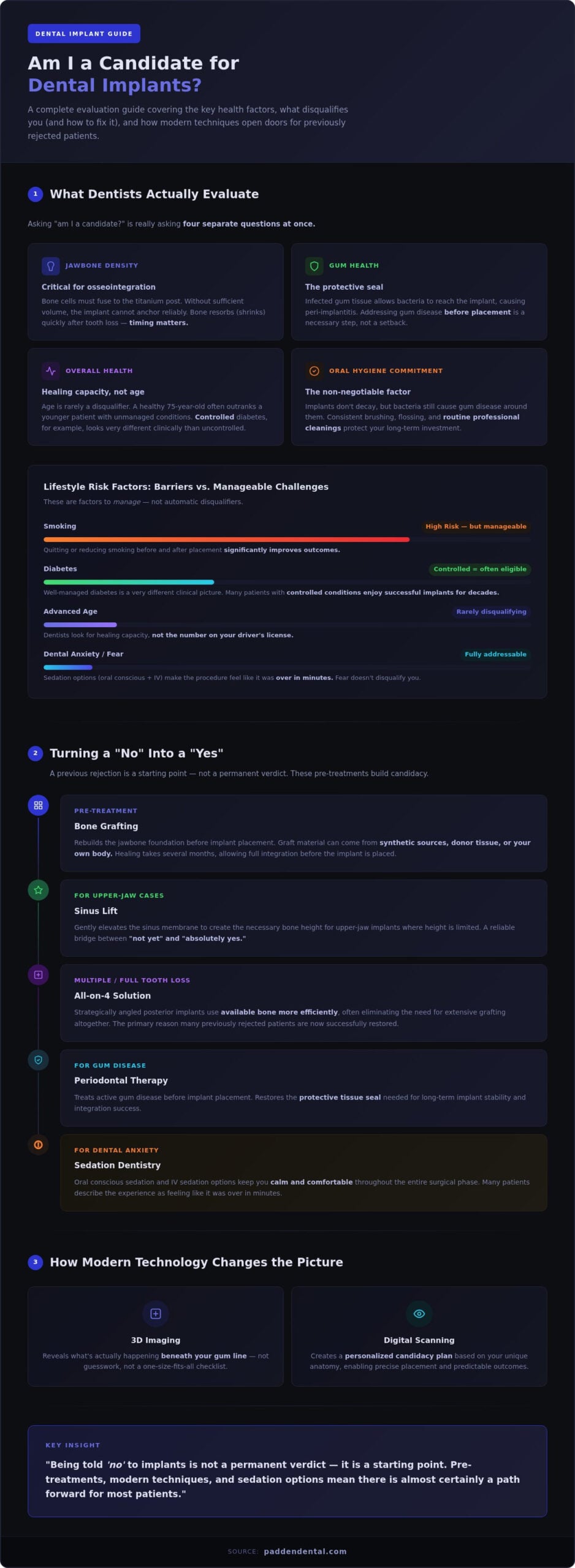
Asking “am I a candidate for dental implants” is really asking four separate questions at once. Dentists evaluate your jawbone, your gum tissue, your overall health, and your commitment to caring for the result. Understanding each factor clearly helps you walk into a consultation with realistic expectations and genuine confidence.
The Role of Bone Density and Gum Health
Every implant depends on a process called osseointegration, where bone cells attach directly to the titanium post and fuse it permanently into your jaw. Without adequate bone volume, that fusion simply can’t happen reliably. This is why timing matters more than most patients realize. When a tooth is lost, the surrounding bone begins to resorb, or shrink, relatively quickly. The longer that gap goes untreated, the less foundation remains to work with.
Healthy gum tissue is equally critical. Gums act as the protective seal around the implant site. When that tissue is compromised by infection or disease, bacteria can reach the implant and cause peri-implantitis, a condition that threatens the long-term stability of the entire restoration. Addressing gum disease before placement isn’t a setback; it’s a necessary step toward a lasting outcome.
Age and Lifestyle Factors: Are You Ever “Too Old”?
Age alone is rarely a disqualifier. For seniors, the more meaningful question is overall health status. A healthy 75-year-old is often a stronger candidate than a younger patient with unmanaged systemic conditions. What dentists look for is your body’s capacity to heal, not the number on your driver’s license.
Smoking and alcohol use do increase complication risks, but they’re better understood as factors to manage rather than automatic barriers. Patients who reduce or quit smoking before and after placement significantly improve their outcomes. The same logic applies to systemic conditions like diabetes: controlled diabetes is a very different clinical picture than uncontrolled diabetes, and many patients with well-managed health conditions go on to enjoy successful implants for decades.
One factor that is genuinely non-negotiable is your commitment to oral hygiene. Implants don’t decay the way natural teeth do, but they’re still vulnerable to the bacteria that cause gum disease. Consistent brushing, flossing, and routine professional cleanings are what protect your investment long-term.
Turning a “No” Into a “Yes”: How to Become a Candidate
A previous “no” from a dentist isn’t a permanent verdict. It’s a starting point. The question of “am I a candidate for dental implants” has become far more answerable in recent years, because the treatments that build candidacy have advanced right alongside the implants themselves. If bone loss, gum disease, or sheer anxiety has kept you from moving forward, there’s a very good chance a clear path exists.
Overcoming Bone Loss with Advanced Grafting
When there isn’t enough bone to anchor an implant securely, bone grafting rebuilds that foundation before placement even begins. Grafts can be sourced from synthetic materials, donor tissue, or your own body, and your provider will recommend the right type based on the volume and location of bone needed. Healing typically takes several months, allowing new bone to integrate fully before the implant is placed. For patients needing upper-jaw implants where bone height is limited, a sinus lift gently elevates the sinus membrane to create the necessary space. Restorative dentistry in Vancouver WA has made these preparatory procedures a reliable bridge between “not yet” and “absolutely yes.”
For patients who’ve lost most or all of their teeth, All-on-4 solutions work differently than single-implant systems. By angling the posterior implants strategically, the technique uses available bone more efficiently, often eliminating the need for extensive grafting altogether. It’s one of the most significant reasons patients who were previously turned away are now successfully restored.
Managing Dental Fear with Sedation
Fear is a legitimate barrier, and it deserves a real solution. Sedation dentistry in Vancouver WA addresses this directly, offering oral conscious sedation and IV sedation options that keep you calm and comfortable throughout the surgical phase. Many patients describe the experience as feeling like it was over in minutes. Being “too scared” doesn’t disqualify you; it just means your care plan needs to include the right level of support from the very beginning.
Periodontal therapy rounds out the picture for patients with active gum disease. Clearing that infection before implant placement creates a clean, stable environment where the implant can heal without interference. Think of it as preparing the soil before planting something you want to last a lifetime. If you’re ready to explore what your specific path forward looks like, scheduling a consultation with Dr. Padden is the natural next step.
Taking the Next Step: Your Consultation in Vancouver, WA
Knowing you want implants and knowing exactly where you stand are two different things. The only way to move from “am I a candidate for dental implants” to a clear, confident answer is a proper evaluation with someone who can actually see what’s happening beneath your gum line. At Padden Dental, that process starts with technology, not guesswork.
Dr. Padden uses advanced 3D imaging and digital scanning to map your bone structure, gum tissue, and surrounding anatomy with a level of detail that traditional X-rays simply can’t match. That precision matters because your candidacy plan is built around your specific anatomy and health history, not a generic checklist. Two patients with similar tooth loss can have very different treatment paths, and the imaging makes those differences visible from the very first appointment.
What to Expect During Your Padden Dental Consultation
Your first visit is non-invasive and genuinely straightforward. Dr. Padden’s team will review your medical history, capture the necessary scans, and spend real time understanding what you want your smile to look like and how you want it to function. There’s no pressure, no rushed decisions, and no clinical coldness. Padden Dental has been part of the Vancouver community since 2004, and that longevity shows in how the practice treats people: like neighbors, not appointments.
If you’ve already been told “no” by another provider, this is exactly where a second opinion pays off. A specialized implant clinic evaluates your case with a broader toolkit than a general practice might, and what looked like a dead end elsewhere often has a clear solution here.
Financing Your New Smile
The cost of dental implants is a real consideration, and the team at Padden Dental helps you navigate it honestly. They work with patients on insurance coordination and third-party financing options like CareCredit to make treatment accessible across different budgets.
It’s worth framing implants as what they actually are: a long-term investment in your ability to eat well, speak clearly, and protect your remaining bone structure. Cheaper short-term alternatives often carry long-term costs that exceed the implant investment itself. Your smile, your health, and your confidence deserve a solution built to last.
Your Path to a Restored Smile Starts Here
If you’ve spent any time wondering “am I a candidate for dental implants,” this guide has shown you one consistent truth: the answer is rarely as simple as a flat no. Bone loss can be rebuilt. Gum disease can be treated. Even deep dental anxiety has a real solution in sedation dentistry. What once felt like a closed door is, for most patients, simply a door that needs the right key.
Padden Dental has been serving the Vancouver community since 2004, and that experience shows in how complex cases are handled, from All-on-4 restorations for patients with significant bone loss to sedation options that make the entire process genuinely comfortable. Dr. Padden’s team meets you where you are and builds a plan around your specific needs, not a generic checklist.
The best thing you can do right now is take the first step. Schedule your dental implant consultation at Padden Dental today and find out exactly what your path forward looks like. A confident, fully restored smile is closer than you think.
Frequently Asked Questions About Dental Implant Candidacy
Can I get dental implants if I have osteoporosis?
Osteoporosis doesn’t automatically disqualify you, but it does require careful evaluation. The primary concern is whether the jawbone has sufficient density to support osseointegration. A complicating factor is bisphosphonate medications, commonly prescribed for osteoporosis, which can affect bone healing around implant sites. Your provider needs a complete picture of your medication history and current bone health before making any recommendation.
The good news is that many patients with osteoporosis do go on to receive successful implants, particularly when their condition is well-managed and their jaw retains adequate bone volume. A 3D imaging scan gives a far more accurate assessment than a general diagnosis alone ever could.
Is there an age limit for dental implant surgery?
There’s a minimum age consideration but no upper limit. Younger patients need to wait until jawbone growth is complete, typically in the late teens or early twenties, because placing an implant in a still-developing jaw can lead to misalignment over time. On the other end of the spectrum, healthy older adults are regularly successful implant candidates well into their seventies and beyond.
What matters at any age is your body’s ability to heal and your overall health status. A thorough consultation will assess those factors directly rather than making assumptions based on age alone.
What health conditions automatically disqualify you from dental implants?
Very few conditions are absolute disqualifiers. Uncontrolled diabetes, active cancer treatment involving radiation to the jaw, and severe immune deficiencies can make implant placement unsafe until those conditions are stabilized or treated. The distinction between “uncontrolled” and “well-managed” is genuinely significant here; the same diagnosis can produce very different candidacy outcomes depending on how it’s being treated.
Can I get implants if I have been missing teeth for many years?
Yes, though longer gaps between tooth loss and treatment typically mean more bone resorption has occurred. This is one of the most common reasons people asking “am I a candidate for dental implants” assume the answer is no after years of waiting. The reality is that bone grafting can rebuild the foundation needed for placement, and solutions like All-on-4 are specifically designed to work efficiently with the bone that remains.
Years of missing teeth don’t close the door; they just shape which treatment path makes the most sense for your situation. An imaging scan will show exactly what’s there to work with.
How long do I have to wait for implants after a bone graft?
Healing timelines vary based on the size and location of the graft, but most patients wait roughly four to six months before implant placement begins. That window allows new bone to integrate fully, creating a stable foundation that supports long-term implant success. Trying to shorten that timeline isn’t advisable; the healing phase is doing essential structural work.
Your provider will monitor healing progress and confirm readiness before moving forward. Some patients find the waiting period easier to manage when they understand it’s an active part of building a result that’s designed to last decades.
Does insurance cover the cost of a dental implant consultation?
Coverage varies widely depending on your specific plan. Some dental insurance policies cover a portion of the consultation or the imaging involved, while others treat implants as a purely cosmetic procedure and exclude related costs entirely. The most reliable approach is to contact your insurance provider directly before your appointment and ask specifically about diagnostic imaging and implant-related consultations.
If out-of-pocket costs are a concern, it’s worth asking the dental team about third-party financing options that can spread treatment costs over time. Understanding your financial picture upfront makes the path forward far less stressful.