



Imagine sitting down to a meal at your favorite Vancouver bistro, eyeing a crisp apple or a perfectly seared steak, only to feel a familiar wave of hesitation. You’re not just worried about the food; you’re worried that your teeth might shift or fall out at the worst possible moment. If you’ve experienced these problems with dentures slipping, you know that the physical discomfort of painful sores is often matched by the social anxiety of a public mishap. You aren’t alone in this journey, and it’s important to know that a loose fit isn’t a personal failure.
We believe everyone deserves a secure, “set-it-and-forget-it” smile that feels as natural as it looks. In this article, you’ll discover the biological reasons why your dentures are moving and learn about the professional solutions available to fix them. We’ll explain the difference between a simple bad fit and the natural bone changes that happen over time. From gentle adjustments to life-changing dental implants, we’ll preview the local options that can help you regain your confidence and enjoy your favorite foods once again.
Key Takeaways
- Learn why natural jawbone changes and the “suction factor” affect how your dentures stay in place during everyday activities.
- Discover how to tell if you are using adhesives to mask underlying problems with dentures slipping or if a professional reline is the better path forward.
- Use the “Apple Test” to gauge your current stability and understand when a shift in fit requires expert attention.
- Explore how dental implants provide a permanent foundation by mimicking natural tooth roots and helping to preserve your jawbone health.
- Understand the benefits of modern snap-in dentures as a reliable, secure solution for a more confident and comfortable lifestyle.
Why Do Dentures Slip? Understanding the Mechanics of Your Smile
Slippage isn’t just a minor annoyance; it’s the unwanted movement of your prosthetic when you should be focusing on a punchline or a meal. When you face problems with dentures slipping, it often feels like your smile has a mind of its own during simple tasks like laughing or chewing. This movement usually happens because the physical bond between the acrylic and your gums has been compromised by changes in your mouth.
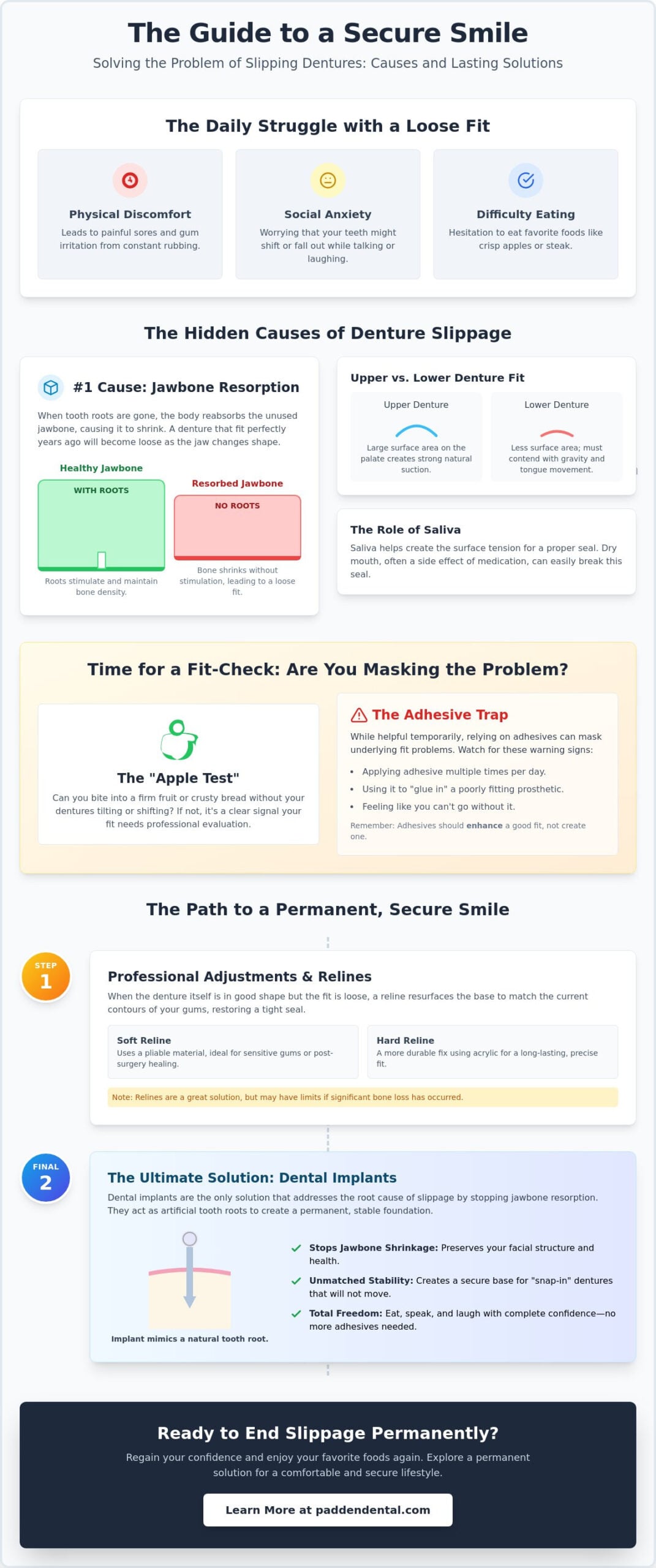
Understanding the Mechanics of Your Smile helps explain why some dentures stay put better than others. Upper dentures typically benefit from a large surface area on the roof of your mouth, which creates a natural suction. Lower dentures, however, have a much tougher job. They must contend with gravity and the constant motion of your tongue, which can easily unseat a prosthetic that isn’t perfectly balanced to your unique anatomy.
Your saliva plays a silent but vital role in this process by acting as the moisture that maintains the surface tension of your denture’s seal. If you struggle with dry mouth, a common side effect of many medications, that seal can break quite easily. Without a healthy layer of moisture, even a well-made denture can begin to slide during a quick conversation or a hearty laugh.
If you’re tired of guessing when your teeth might move, exploring restorative dentistry in Vancouver WA is a wonderful way to identify the root cause of your problems with dentures slipping. Our team focuses on the human element of care, ensuring your comfort is the priority while we evaluate the fit of your prosthetic.
Jawbone Resorption: The Hidden Cause of Slippage
Tooth roots do more than just hold your teeth in place; they stimulate your jawbone to keep it strong and dense. When those roots are no longer present, your body naturally begins to reabsorb the bone tissue because it’s no longer being used. This is why a denture that felt secure two years ago might feel like it’s loose or wobbling today. Alveolar bone resorption is the medical term for this natural shrinkage of the jawbone that leads to long-term denture instability.
Practical Solutions for Slipping Dentures: From Adhesives to Relines
Many people turn to drugstore gels and powders as their first line of defense against a loose fit. While these can offer a temporary boost in confidence, it is easy to fall into a cycle where you are simply masking the underlying problems with dentures slipping. Following the FDA advice on denture adhesives is vital; these products are meant to enhance a well-fitted prosthetic, not act as a permanent crutch for one that no longer fits. If you find yourself applying adhesive multiple times a day just to get through a conversation, your mouth is likely telling you that the physical shape of your gums has changed.
Have you tried the “Apple Test” lately? It’s a simple, practical way to check your stability at home. If you cannot bite into a solid fruit or a piece of crusty bread without your teeth tilting or shifting, it is a clear signal that your current fit needs a professional evaluation. Sometimes, these changes happen for reasons you might not expect. Significant weight loss, for example, can actually reduce the fatty tissue in your gums, altering the “landscape” your dentures sit upon and requiring a fresh look at your prosthetic’s base.
We understand that visiting the dentist can feel overwhelming for some patients. If the thought of dental work makes you nervous, sedation dentistry in Vancouver, WA provides a peaceful, anxiety-free way to handle your adjustments. This gentle approach allows us to focus on your comfort while we restore the security of your smile.
Professional Adjustments and Relines
When a denture is still in good condition but no longer hugs your gums, a reline is often the best path forward. A soft reline uses a pliable, medicinal material that is great for patients with sensitive gums or those healing from surgery. For a more permanent fix, a hard reline reshapes the denture base with durable acrylic to match the current contours of your jaw. These adjustments help eliminate the common problems with dentures slipping by restoring the tight seal you once enjoyed. However, if the bone has changed too much over the years, even a hard reline may have its limits, and it might be time to discuss more stable, long-term options.
Ending Slippage Permanently with Dental Implants
While relines and adhesives offer temporary relief, they don’t address the underlying biological changes in your jaw. Dental implants are the only restorative solution that truly stops jawbone shrinkage because they mimic the function of natural tooth roots. By providing constant stimulation to the bone, they help maintain your facial structure and create a rock-solid foundation for your smile. At our dental implant clinic, we specialize in helping patients transition from the frustration of moving prosthetics to the peace of mind that comes with a permanent fit.
For many, snap-in dentures serve as an excellent middle-ground solution. This option uses a few strategically placed implants to “anchor” a removable prosthetic, effectively ending the most common problems with dentures slipping during meals or conversations. It’s a reliable way to regain your confidence without a completely fixed bridge, giving you the stability you need to live life on your own terms.
The All-on-4 System: Stability Without the Slip
The All-on-4 system is a life-changing advancement for anyone tired of dealing with loose teeth. This technique uses four precision-placed implants to support a full, non-removable arch of teeth that stays in your mouth 24/7. You can finally say goodbye to messy adhesives and the ritual of nightly soaking. Because this system is fixed, your biting force returns to near-natural levels, and you’ll likely notice that food tastes better since the roof of your mouth is no longer covered by bulky acrylic.
Our team takes great pride in the artistry of our work. We use the principles of cosmetic dentistry in Vancouver, Washington to ensure your new smile isn’t just functional, but also beautiful and natural-looking. We’ll work closely with you to choose the right shade and shape, ensuring your results reflect your personality and help you feel like yourself again. It’s time to stop worrying about your teeth and start enjoying the secure, radiant smile you deserve.
Rediscover the Joy of a Confident Smile
Living with the daily uncertainty of a moving smile can take a toll on your social life and physical comfort. We’ve explored how biological changes in the jaw often lead to problems with dentures slipping, but these challenges don’t have to be your permanent reality. Whether you need a precise reline to restore your current fit or you’re ready to explore the life-changing stability of All-on-4 dental implants, there is a path forward that leads back to your favorite foods and confident laughter.
With over 20 years of experience in restorative care, our team is dedicated to providing a high standard of clinical excellence paired with neighborly warmth. We offer advanced All-on-4 technology for those seeking permanent stability and in-house sedation options to ensure your journey is completely comfortable and stress-free. You don’t have to navigate these changes alone; we are here to act as your trusted partners in health.
Schedule your denture stability consultation with Dr. Padden today and take the first step toward a secure, worry-free future. We look forward to welcoming you into our office and helping you reclaim the smile you deserve.
Answers to Your Common Denture Questions
Why do my dentures click when I talk?
Clicking usually happens because the dentures are loose or the vertical dimension of your bite is slightly off. When the prosthetic doesn’t sit snugly against the gums, it can shift and tap against the opposite arch while you speak. This is a clear sign that the fit needs a professional adjustment to ensure the teeth stay in their proper position during conversation.
How often should I have my dentures relined to prevent slipping?
You should generally have your dentures relined every two to three years to maintain a secure fit. Because your jawbone naturally changes shape over time, the prosthetic that fit perfectly on day one will eventually lose its seal. Regular relines help address common problems with dentures slipping by filling in the gaps created by these natural biological shifts.
Can I fix my slipping dentures at home with a kit?
It’s best to avoid using over-the-counter repair or reline kits because they can permanently damage your prosthetic and irritate your oral tissues. These kits often use materials that aren’t biocompatible and can change your bite alignment in ways that are difficult for a professional to correct later. A clinical adjustment is the only safe way to ensure your smile remains healthy.
Are dental implants worth it if my dentures already slip?
Dental implants are an excellent investment for those struggling with instability because they provide a fixed anchor that mimics natural tooth roots. Unlike traditional prosthetics that rely on suction, implant-supported options stay locked in place regardless of what you eat or how much you talk. They offer a level of security and bone preservation that traditional dentures simply cannot match.
What is the best adhesive for slipping lower dentures?
The best adhesive is typically a zinc-free cream or powder that provides a reliable hold without the risks associated with excessive zinc intake. However, even high-quality products are only a temporary fix for problems with dentures slipping. If you find yourself relying on adhesives daily, it’s a strong indication that the base of your denture no longer matches the contours of your mouth.
Will new dentures stop slipping immediately?
New dentures should provide an immediate improvement in stability, though there’s usually a brief adjustment period as your facial muscles learn to work with the new prosthetic. A well-crafted set of teeth will utilize the natural suction of your mouth and the strength of your cheeks to stay secure. If slippage persists after the first few weeks, a minor professional adjustment can usually resolve the issue.